Siekopai Tribe's Land Back on the Rio Aguarico
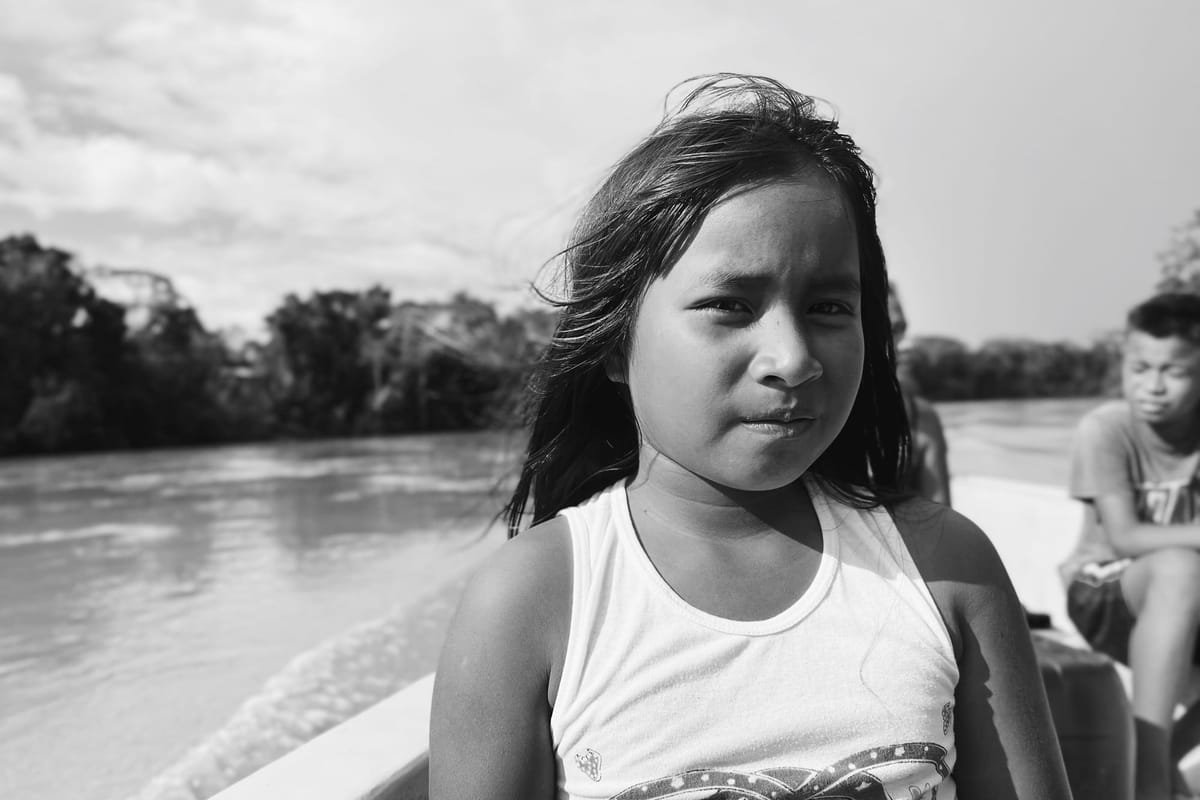
Rio Aguarico, Sucumbíos Ecuador – Amazon Basin
In late November of 2023, the Siekopai Nation won a historic lawsuit in the provincial court of Sucumbíos, Ecuador to deliver land back and title for 104,000 acres of biodiverse rainforest in their territorial homeland Pëekë'ya (Lagartococha). The lawsuit was founded on the state of Ecuador’s violation of the Siekopai’s collective territorial rights recognized by international law and Ecuador’s Constitution. (Amazon Frontlines, 2023).
Pëekë'ya is a region located on the border between Ecuador and Peru that was disputed during a war between the two countries in 1941, that displaced the Siekopai from their ancestral territory.
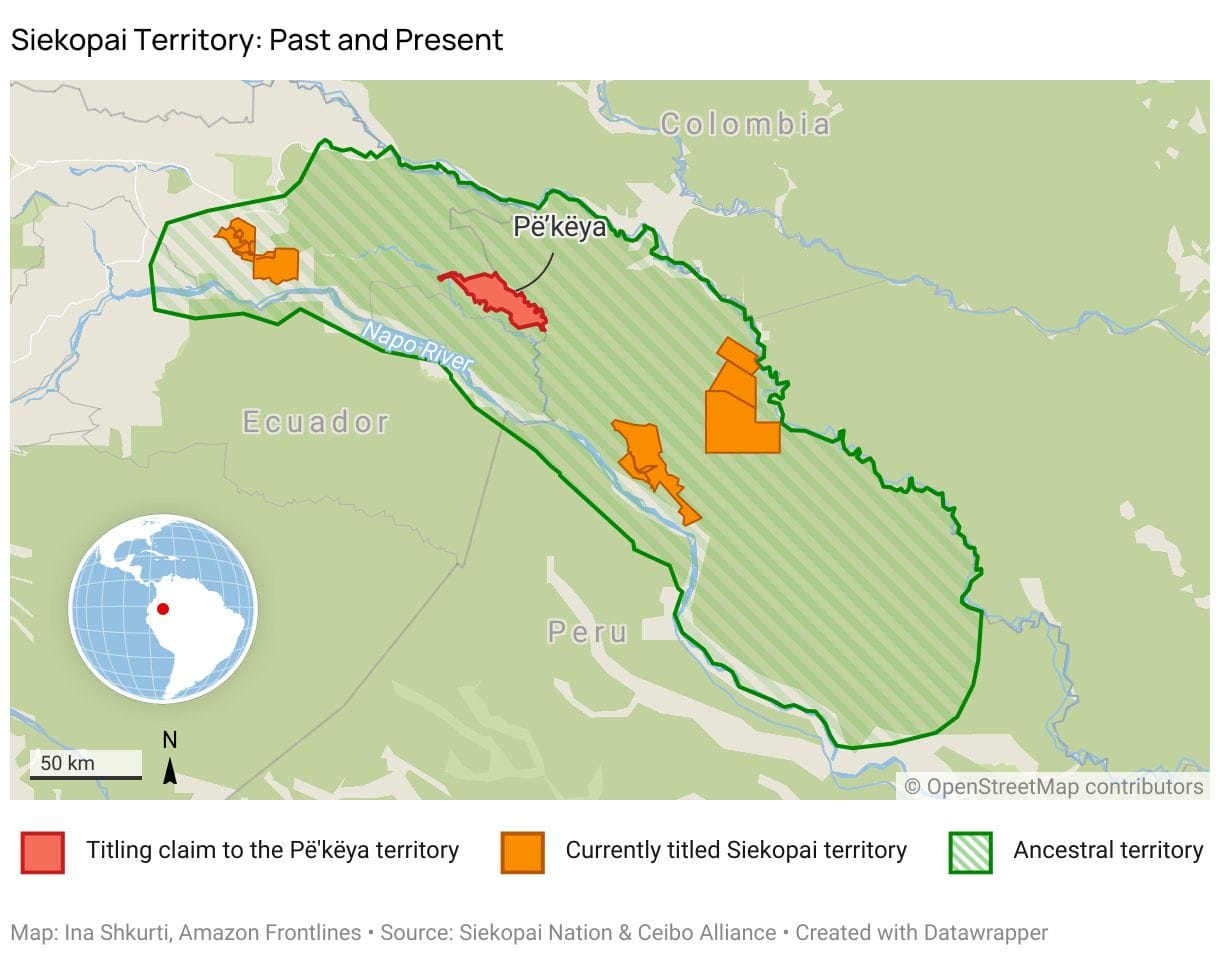
“We are here in the Nation Siekopai on the Rio Aguarico. We are the original inhabitants of the place we call Lagartococha, that is our place of spiritual connection.” Colon Piagauje
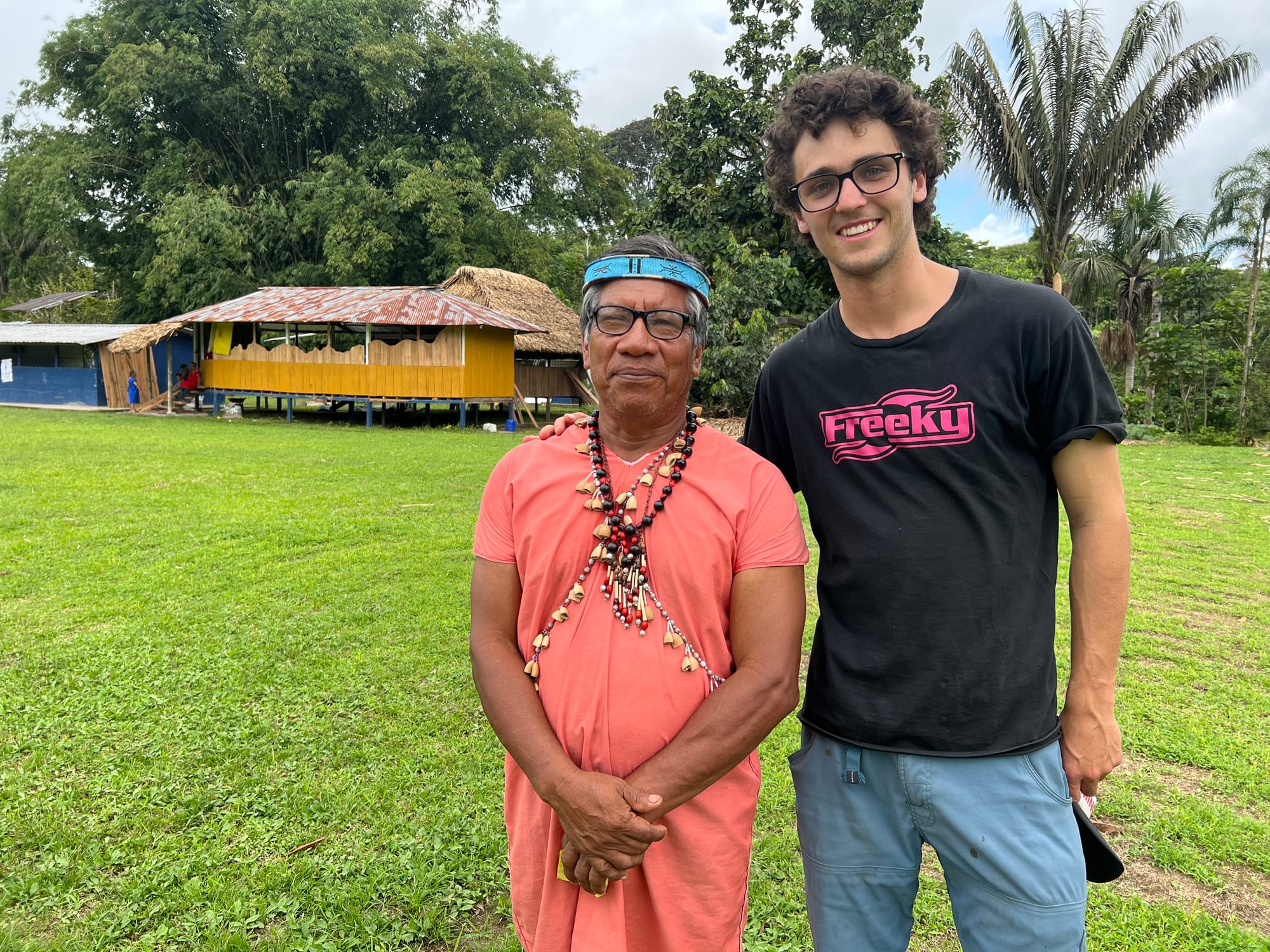
A Journey to the Edge
In June of 2023, I made a visit to the Siekopai’s territory with a friend Diego Robles, whose father used to run supplies on canoes to the communities along the Aguarico River. To get there we drove on decrepit a road around the largest Amazonian Volcano in Ecuador, Sumaco, where it crossed over the flanks of the massive mountain, before it dropping around steep corners into the flatlands of the Amazon.
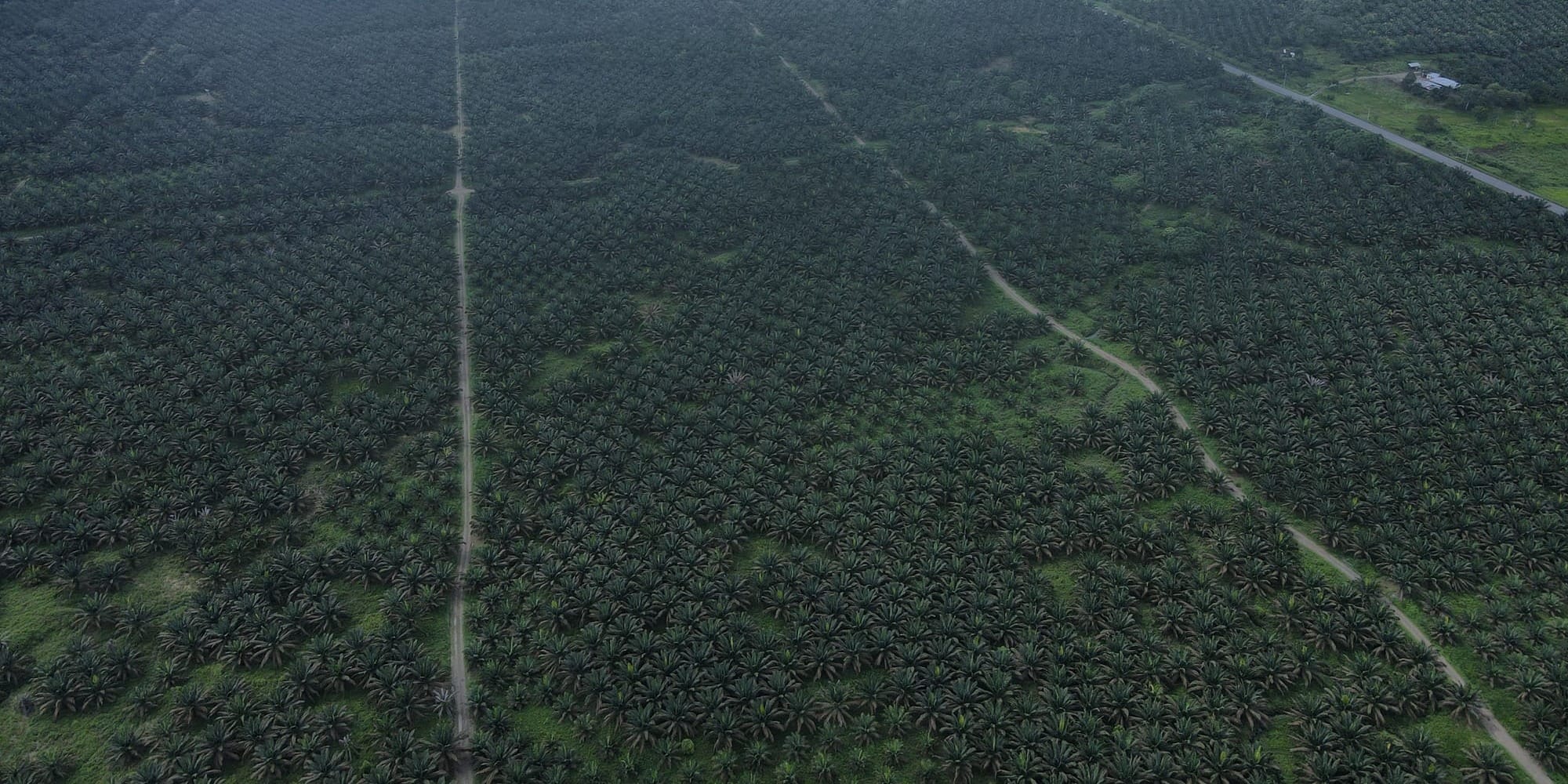
Small roadside Kichwa Indigenous communities merged into the bustling oil city of San Francisco de Orellana (Coca). Along the road, U.S. stylized hotels are commonly found for oil business executives. Continuing north, the road straightens all the way to the border with Colombia. Where unmarked oil pipelines dissect the deforested landscape.
The Rio Aguarico region in the province of Sucumbíos in Ecuador, has been called by renowned journalist and human rights lawyer Stephen Donzinger as the “Amazons Chernobyl”, due to the large US oil company Texaco’s oil spills in Aguarico River and the oil village of Shushufindi.
In 1967, a Texaco discovered a rich oil beneath the rainforest, leading to an oil boom that has permanently altered the landscape. The region now is a vast network of roads, pipelines and oil facilities. Settlers attracted by the roads and encouraged by government land policies have entered in large numbers, deforesting vast regions of the rainforest and displacing indigenous inhabitants. (Rotberg, 1994).
For hours we drove on a road developed within the last ten years cut in a straight line to reveal the vast expanse of palm oil plantations, mono cropped African palm trees. Used to create palm oil products around the world. Reaching the end of the road and heading further downstream via motorized canoe, where we met Colon Piaguaje, the Administer of Health for the Siekopai from the Communidad Secoya Remolino.
"There are many grave issues we are facing in the territory of the Siekopai, it was first the invasions of our territory that we have faced from colonization, and then the impacts of industrial agriculture companies of African palm plantation, with that came the exploration petroleum of the state-run oil companies. These are the gravest issues we have faced, and we have declared that we will live a dignified way of life, conserving our way of life and the environment, and the flora and fauna as it is part of our spiritual connection.” Colon Piajuaje
Border War of 1941 – 1942
The Siekopai were forced off their ancestral territory of Lagartococha by the 1941 territory war between Peru and Ecuador. Their mission to reclaim land is an act of resurgence and return to a homeland of a people who have long faced oppression and dispossession of lands in their territory since the onset of colonization. “The war was an enormous blow to the social-territorial fabric of the Siekopai nation, and their fluid borderless existence. Both national armies deemed the Siekopai nation as spies. A militarized border was erected between Peru and Ecuador, driving families apart, and uprooting the Siekopai nation from their home. Many families – siblings, cousins, parents, children – were split and splintered. Some would never be reunited; others would only see each other after decades.”(Amazon Frontlines, 2022).
Lagartococha following the war remained heavily militarized and continued to prevent the Siekopai form returning to their territory. The result of their displacement has forced a separation of the Nation across the border between Ecuador and Peru, separating families for multiple generations. Many of those displaced families remain today on depleted territories, surrounded by oil companies and palm plantations, like the villages along the Rio Aguarico. (Amazon, 2022)
Cuyabeno Reserve – Conservation or Colonization?
In 1979, the president of Ecuador established a national system of protected wildlife areas, which made Lagartococha part of the newly established Cuyabeno Wildlife Reserve. The state's creation of Lagartococha as a conservation area, valued threatened species over human rights, and can be seen as further step in the process of land dispossession, reducing indigenous peoples role as potential co-managers of public land (Galvez, 2022). Colon Piajauje, also spoke to the impacts the federal wildlife preserve has had on his peoples traditional ways of life.
“The federal reserve Cuyabeno doesn’t allow us ownership over this land, and we are now working with a judge to give us our land, we have started a legal battle in the tribunal courts of the province of Sucumbíos to reconnect to our spiritual homelands."
In post-independence Ecuador, contests over land have roots in the Ley de Reforma Agraria y Colonización of 1964, and the characterization of the Amazonian hinterland as tierras baldias (empty lands). These policies were implemented with a view to modernize the state, increase agricultural production and obtain control over the national territory and border regions, putting the Siekopai under increasing pressure from hydrocarbon extraction, expansion of industrial agriculture and an unregulated invasion of land” (Galvez, 2022).
The Future for the Siekopai in Pë’këya
According to Amazon Frontlines, an international NGO working with the Siekopai in their legal battle, “The Siekopai’s court victory recognizing Pë’këya marks a major steppingstone in this binational struggle for the reunification of their ancestral territory. After centuries of violence, racism, and conquest by colonizing missions, rubber corporations, and governments, the court’s recognition of the Siekopai as the owners of Pë’këya is an indispensable step towards restoring justice and guaranteeing their collective survival and the continuity of their culture.”. It is also a major step in terms of setting precedent for future indigenous land back cases in protected areas with Ecuador and throughout Latin America.
Sources:
Amazon Frontlines. (2023). Ecuador’s Siekopai Nation Wins Historic Land Back Victory in the Amazon Rainforest. Amazon Frontlines. https://amazonfrontlines.org/chronicles/ecuadors-siekopai-nation-wins-historic-land-back-victory-in-the-amazon-rainforest/
Amazon Frontlines. (2022). Stolen Indigenous Land: The Siekopai's Struggle for Lagartococha in the Amazon. Amazon Frontlines.https://amazonfrontlines.org/chronicles/stolen-indigenous-land-siekopai-lagartococha-amazon/
Gálvez, A. (2022). Expanding the notion of borderlands: Transborder land dispossession, gendered violence, and embodied resistance. Border-Lines, 21(1), 77-98. https://onlinelibrary.wiley.com/doi/10.1111/blar.13524?af=R
Rotberg, R. I. (1994). The New Nature of Nation‐State Failure. The Washington Quarterly, 25(3), 85-96.https://www.jstor.org/stable/4065263?casa_token=pcfaVallzJsAAAAA%3Au9vLpqXVhAYZZJNzwA3H9V72hJa4d320tHsFzeEDmcKmoF37CjZMURUgHmemLX3FHXuFwn6rfTmQQ0aojL0CJLDlYnQTxrmDszk9p6xaErTzTcxmdgtc&seq=2